
Flat head in babies (plagiocephaly): what can you do?
Have you noticed that the back or one side of your baby's head is becoming flat? This is common in the first months and is called positional plagiocephaly. It is usually harmless and often improves with simple steps, especially when you act early. Here is how to understand it, what you can do at home and what an osteopath can offer, working with your paediatrician.
Why does a baby's head become flat?
At birth, the bones of the skull are not yet fused together. They stay flexible to allow the brain to grow, and the head grows particularly fast in the first months. If the head often rests on the same area for long periods, that area can gradually flatten.
There are generally two forms:
- plagiocephaly, a flattening on one side of the back of the skull, sometimes with the ear or forehead on the same side shifted slightly forward;
- brachycephaly, a more symmetrical flattening of the whole back of the head, which then looks wider.
These changes in head shape have become more common since parents have been advised to put babies to sleep on their back. This advice nonetheless remains essential, because it reduces the risk of sudden infant death syndrome. The answer is therefore never to change the sleeping position, but to act during the times your baby is awake.
The factors that encourage a flat head
Several things can lead to repeated pressure on the same area:
- a preference for turning the head to one side only, sometimes linked to stiffness or tension in a neck muscle, known as infant torticollis;
- long periods spent on the back, in the cot, the bouncer or the car seat;
- little time spent on the tummy while awake;
- a cramped position in the womb in late pregnancy, a twin pregnancy or a premature birth.
Identifying what keeps the pressure in place helps you choose the right steps.
The everyday steps that help
These steps follow current recommendations and remain the foundation of care.
- Always sleeping on the back, on a firm mattress, without a pillow, sleep positioner or cot bumper. Pillows sold to ‘prevent flat head’ are not recommended in the cot, as they increase the risk of suffocation.
- Tummy time, when your baby is awake and always supervised, several times a day. Start with short periods, for example lying on your chest or on a mat, then make them longer as your baby gets stronger.
- Drawing attention to the less-used side: talk to your baby and place toys and sources of light on the side they turn towards less readily.
- Alternating: switch arms when carrying and feeding, and alternate the end of the cot where you lay their head.
- Less time in seats: keep the car seat for journeys and limit time in the bouncer.
- Carrying, in your arms or in a baby carrier that properly supports the head and back, takes all pressure off the back of the skull.
When the neck seems stiff
If your baby cannot turn their head fully to one side, keeps it tilted, or if you feel a small lump in a neck muscle, talk to your paediatrician. They can refer your baby to a physiotherapist experienced with infants, who will show you suitable exercises.
When to see the paediatrician first
The paediatrician is your main point of contact for any change in the shape of the skull. In particular, they check that it really is positional plagiocephaly and not craniosynostosis, that is, the premature fusion of certain bones of the skull. This condition is rare, but it requires specialist medical care. See your paediatrician without delay if:
- the shape of the head is getting worse despite the recommended steps;
- the change in shape was already obvious at birth, or you can feel a hard ridge on the skull;
- the head circumference seems not to be increasing, or to be increasing too quickly, or the fontanelle (the soft spot on the head) looks bulging;
- your baby does not turn their head to one side at all, or their movements seem uneven between the two sides;
- they do not follow things with their eyes, seem very floppy or very stiff, or you have concerns about their development;
- they have a fever, refuse to drink, vomit repeatedly or are unusually drowsy.
If your baby has difficulty breathing, has a fainting episode or has a seizure, call 144, the emergency number, immediately.
What the osteopath does during a session
After talking with you about the pregnancy, the birth and your baby's habits, the osteopath looks at the shape of the head from several angles. They also look at how freely the neck moves, how your child lies on their back and on their tummy, and their ability to turn their head to both sides.
The techniques are gentle: light pressure and slow movements of the neck, shoulders, back and pelvis. They aim to make it easier for your child to move, particularly to turn their head, so that the pressure is spread more evenly. To be clear: osteopathy does not reshape the skull on its own. It complements the repositioning steps, which remain the foundation, and medical follow-up.
We also show you suitable positions for play and carrying. Our approach to babies and young children is described on the page osteopathy for babies and children. For other reasons to bring your baby to see us, you can read our article osteopath for babies, when to go.
This article was written by Zaylie Frieden, assistant osteopath at the practice. If you would like an assessment for your baby, you can book an appointment in Lausanne, online or by phone.
Frequently asked questions
Is a flat head serious for my baby?
Positional plagiocephaly is usually harmless. It is up to the paediatrician to confirm that this is the form your baby has, to rule out another, rarer cause and to monitor the growth of the head as well as your child's development.
Should I stop putting my baby to sleep on their back?
No. Sleeping on the back remains the recommended position. Instead, the focus is on the times your baby is awake: supervised tummy time, carrying, alternating sides and less time in seats.
Is a helmet necessary?
In most cases, no. For some marked changes in shape, or ones that do not improve, the paediatrician may refer you to a specialist consultation, where the possible benefit of a cranial orthosis (a moulding helmet) will be discussed. This is a medical decision.
When should we see an osteopath?
Fairly soon after you notice the flattening, and once the paediatrician has seen your baby. The first months are when the head grows fastest: this is the time when everyday steps are most likely to help.
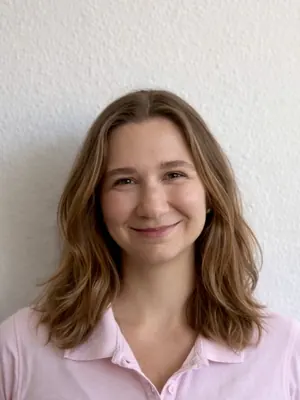
Written by Zaylie Frieden, assistant osteopath at Georgette Ostéopathie. Graduate of the European School of Osteopathy in Maidstone (UK).
Book an appointment
Request an appointment online in a few clicks, or call us on 021 320 45 05, Monday to Friday, 8 am to 6.30 pm.
Prefer to pick a free slot yourself? See availability on OneDoc
Further reading
Osteopath for babies: when should you go?
The situations in which an osteopath can support your baby, how a session works and the signs that mean you should see the paediatrician first.
Julie Feihl · 6 min read
Back pain: when should you see an osteopath?
Is your back hurting, or does the pain keep coming back? Find out when to see an osteopath, and when to see a doctor first.
Matthieu Chappot · 6 min read