
Osteopath for babies: when should you go?
A baby who always turns their head to the same side, a long birth, crying that worries you: many parents wonder whether it is worth seeing an osteopath, and when. Osteopathy can support your child's comfort with very gentle techniques, but it never replaces the care of your paediatrician. Here are our guidelines to help you know when to book a session, and above all when not to wait before calling the doctor.
What osteopathy can offer a young baby
With very young children, the osteopath works with their hands, using light pressure and slow, gentle movements. There is no cracking and no sudden movement. The aim is to observe how your baby moves, whether they turn their head as easily to one side as to the other, how they hold themselves in your arms or on their back, and to identify any areas of tension.
A session aims to improve your child's mobility and comfort. It does not make a medical diagnosis, does not treat illness and does not guarantee any result. It complements the care provided by your paediatrician and, in the first weeks, by your midwife.
Our approach to babies and young children is described on the page osteopathy for babies and children.
The situations that often bring parents to see us
There is no official list, but certain situations come up often:
- A difficult birth: very long or very fast labour, a delivery with ventouse or forceps, an emergency caesarean. The baby is often perfectly well, but some parents would like to have things checked.
- A head always turned to the same side: the baby sleeps, feeds or looks almost always in the same direction. This habit can contribute to a flattening of the back of the skull, which we discuss in our article on flat head in babies.
- Feeding that seems uncomfortable on one side: the baby arches, or lets go of the breast or bottle sooner on one side than on the other. The advice of your midwife or a lactation consultant comes first, and the osteopath's work is complementary.
- A baby who seems tense: they often arch their back, find it hard to relax in your arms or seem uncomfortable in certain positions.
Prolonged crying has many possible causes, and it is up to the paediatrician to assess them first. We do not promise to make crying or colic go away.
When to see the paediatrician or go to the emergency department first
Some signs fall outside the scope of osteopathy and need prompt medical advice. Contact your paediatrician, the out-of-hours doctor service or the paediatric emergency department without delay if your baby:
- has a fever: under three months of age, a temperature of 38 °C or more needs immediate medical advice;
- refuses to drink, drinks much less than usual or has noticeably fewer wet nappies;
- vomits repeatedly, vomits forcefully (projectile vomiting) or brings up green vomit;
- is unusually floppy, drowsy or difficult to wake;
- cries inconsolably, with a cry that does not sound like them;
- breathes fast or with difficulty, or changes colour (pale, grey or bluish);
- has a bulging fontanelle (the soft spot on the head), spots on the skin that do not fade when pressed, or blood in their stools;
- has had a fall or a knock to the head;
- is not gaining weight well.
If your baby has serious difficulty breathing, has a fainting episode, has a seizure or stops responding, call 144, the emergency number, immediately.
If, during a session, we notice anything unusual, we refer you to your paediatrician before going any further.
How a session with a baby works
The session begins with a conversation. We ask you about the pregnancy, the birth, feeding, sleep, stools and medical follow-up. Bring any documents given to you by your paediatrician or the maternity unit.
You stay with your child throughout the appointment. The osteopath first observes your baby: how they move, turn their head and hold themselves. They then gently feel the skull, neck, back, pelvis and tummy. Your baby can stay in your arms, lie on the table or even feed if that soothes them.
The techniques used are slow and gentle. If your child cries or becomes restless, we take a break and adapt the pace. At the end, we explain what we have observed and give you a few simple tips for home. Members of our team have completed postgraduate training in paediatrics.
What you can do at home
Everyday habits matter as much as the session. They follow current recommendations from paediatricians:
- Always put your baby to sleep on their back, in a cot with no pillow, bumper or soft toys. This is the recommended position to reduce the risk of sudden infant death syndrome.
- Give them tummy time, only when they are awake and supervised, several times a day for short periods. These moments strengthen their neck and shoulders.
- Vary the sides: alternate the arm you carry them in, the side you feed them on, from the breast or the bottle, and the direction their head faces in the cot.
- Limit time spent in seats, such as a bouncer or car seat, outside of journeys.
- Carry them in your arms or in a suitable baby carrier that properly supports their head and back.
If in doubt, ask your paediatrician or midwife for advice.
This article was written by Julie Feihl, osteopath at the practice. If you would like to check on your child's comfort, you can book an appointment at the practice in Lausanne.
Frequently asked questions
From what age can a baby see an osteopath?
There is no strict minimum age. We simply recommend that your baby has first been examined by the paediatrician or midwife, to rule out any medical problem.
Will the session hurt my baby?
The techniques are very gentle and should not hurt. A baby may still cry because they are hungry, tired or do not like being undressed. When that happens, we take breaks.
How many sessions should we expect?
It depends on the situation. We review things with you at the end of each session, without booking appointment after appointment for no reason. If nothing changes, it is best to talk it over again with your paediatrician.
Is the appointment covered by health insurance?
Osteopathy is not covered by basic health insurance (LAMal), the compulsory cover in Switzerland. It may be covered by supplementary insurance (LCA), the optional top-up cover, depending on your policy. All members of our team are recognised by supplementary health insurers. Check with your insurer to find out what your policy includes.
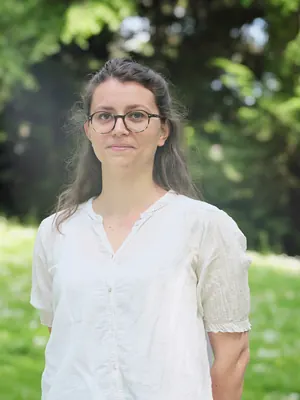
Written by Julie Feihl, osteopath at Georgette Ostéopathie. Graduate of the European School of Osteopathy in Maidstone (UK).
Book an appointment
Request an appointment online in a few clicks, or call us on 021 320 45 05, Monday to Friday, 8 am to 6.30 pm.
Prefer to pick a free slot yourself? See availability on OneDoc
Further reading
Flat head in babies (plagiocephaly): what can you do?
Why a baby's head can become flat, the everyday steps that help and where osteopathy fits in alongside the paediatrician's follow-up.
Zaylie Frieden · 6 min read
Back pain: when should you see an osteopath?
Is your back hurting, or does the pain keep coming back? Find out when to see an osteopath, and when to see a doctor first.
Matthieu Chappot · 6 min read